Páginas

sábado, 24 de agosto de 2013

Come in first, second... What to do? - ¿Primero o segundo? Que hacer?

Hay un rumor basado en la Game Theory o "Teoría del Juego" que dice que llegar segundo gana mas veces que llegar primero, digamos como en Papel-roca-tijeras... Incluso ha habido un par de artículos, uno de ellos en una revista prestigiada en los Estados Unidos. Pero, pregunto yo:

El que todos quieran empezar en una posición cómoda, incluso floja de segundo, ¿Acaso no resulta en una paradoja que termina en que nadie empiece nada?

Parece que se nos olvida que la Teoría del Juego también nos dice que algunos juegos es más relevante empezar primero como en las carreras de autos, las Olimpiadas o el duelo con pistolas, y otros como el ajedrez, maratón o la vida, en realidad no importa.

Aunque cierto es que hay demasiados casos que el que llega segundo termina superando al primero, como los casos de Xerox, Microsoft y Sony versus Apple, KMart vs Walmart, Yahoo vs Google... En todos, los que llegaron primero tuvieron en su momento oportunidad incluso de adquirir a sus competidores cuando todavía eran pequeños... Y porque no lo hicieron, eliminando así esa amenaza competitiva?

Yo creo que es problema de estado mental, de que se despreció la competencia en una posición arrogante donde no se mantuvo el paso, dejando campo libre a quien no tenia nada que perder, arriesgándose y en muchos de estos casos, simplemente ganando, dando como resultado un estado de incredulidad combinada con aversión al riesgo, combinación simplemente letal.

"¿Como llego al otro lado?? " - "Ya estas del otro lado!!"
Hay algunos que se dicen innovadores, como P&G. Esos tipos no toman iniciativas de innovación a menos de que tengan mas de un año en el mercado probado.... En estos días, un año ya todo es viejo.

Y a diferencia del ajedrez y otros juegos, la vida y la humanidad continua.

Alguien en algún momento destronará a Google, y a Apple y a.... todos.

----------------------------


One question regarding the recent frequently cited "first come disadvantage": Wouldn't that just become a paradox of nobody starting anything because everyone is waiting for everybody else to sart something just to grab and become a rather lazy, comfy second?

I do believe that it not matter of starting first, second or third, is more a matter of keeping up with the  pace, so it is rather a mindframing problem. Why did Google overcome Yahoo, and why did Yahoo did nothing against Google? Xerox, Microsoft and Sony vs Apple, KMart vs Walmart... and so many more cases were rather cases of being dismissed as non-threats, thus not taking, or losing the strategic first-come as an advantage, Yahoo lost that first served chance when they chose not to aquire Google when they had that small golden chance.  

True, Game Theory teach us that sometimes is best to be second as in rock-paper-scissors, sometimes is best to be first as in car racing, the Olympics, or a gun duel, and sometimes doesn't really matter as in every complex games happens, as in chess, marathons or true life.  

It is my experience as a strategist and innovator that Arrogant dismissals against the small upcomming underdog IS what happens each and everytime a second commer wins, rarely the other way around. And after that happens, the first-arrival-loser lose because of lost-mind, risk-averse disbelief rather than anything else.  

There are enough big players that call themselves disruptors, like P&G.... Those guys never take on an innovation unless it has been proven in the field for at least a year by someone else, proving their risk-averseness. After a year, nowadays that is just old news.  

And unlike Chess, life and humanity must go on.

Some one at some point will dethrone Apple and google and... everyone.


martes, 13 de agosto de 2013

Focused or unfocused vision, visionary ... Or What? // Vision enfocada, desafocada, visonario o Que?

(English version below)

Ya van un par de platicas que tengo con unas gentes que me acusan: "enfocate!" ...em...

Ha sido mi experiencia que poca gente tiene lo que llamo en términos fotográficos una visión gran angular, y resulta que los psicólogos le llaman "habilidad mental de mosaico", una habilidad un tanto rara de poder enfocar la mente en varias cosas a la vez. Habilidad que la mayor parte de la gente que tiene un pensamiento linear, desecha esa habilidad como "falta de enfoque", que de hecho resulta ser un enfoque mucho mas amplio. en términos fotográficos, de mayor profundidad focal.

En el estudio de Harvard lo visualizan como generalista versus especialistas, del cual ya hable hace muchos posts, el cual describe la riqueza que AMBAS personalidades y formaciones traen a la mesa, a las organizaciones. Ambas visiones deben cohabitar para enriquecer la organización. También es cierto y en base a mi experiencia que dicha cohabitación se convierte rápidamente en pleito y conflicto por la diferencia de perspectivas, cuando de hecho AMBAS tienen razón.

Y obviamente existe una diferencia importante entre visión gran angular a quienes son difusos, dispersos o con déficit de atención. Los cuales también tienen su valor, que quienes acusan de falta de enfoque, me demuestran que no saben bien de que hablan.

En mi practica de consultoria, la visión gran angular, enfoque mosaico ha sido de gran ayuda para resolución de problemas sistemicos bastante complejos, que relativamente pocos han sabido apreciar amablemente.

Lastima de la miopía de la gente "enfocada", me parece que simplemente no tienen la capacidad de entender la "gran imagen".

Me da curiosidad investigar, Porque la gran mayoria de hiperenfocados que conozco son PhD's.. no todos los que conozco, pero demasiados como para decir: hmmmm... Mi teoria es que estan tan especializados, con una saludable (o no tanto) dosis de OCD, digo, tal vez...

Lo que quiero decir con esto es que con mas ganas, y en especial, creo, Ellos necesitan La perspectiva de la gran imagen.

Que es mejor? Claramente, Ambas visones.


I've been in a couple of interviews with a handful of people that just accuse me: "focus yourself!" ... um...

I it's been my personal experience, thus I believe that too few humans have a wide-angle view. Psichologists describe that as mosaic abilities as a rare skill to be able to focus on many things at once, and most "normal" linear thinking people dismiss that rare ability as "lack of focus" which is in fact a wider focal depth.

In an HBR study this was viewed as generalists vs specialists and the richness that both bring to the table. Both views must cohabitate to enrich the company. However, my experience is that such cohabitation becomes conflict of different perspectives, when both are usually correct.

In my consulting practice, a wide-angle vision, mosaic focus has been a marketable skill that just a handful have been able to appreciate, which by the way has been the only path to solve some quite complex systemic problems.

Too bad for some of the shortsightedness of the "focused" crew, they just don't get the whole picture, just right.

I wonder, Why are most of the hyperfocused people I know, PhDs? Not all, but too many to go hmmm...
My theory is that they are deeply specialized, and probably with a healthy (or not so much) doze of OCD, maybe...
All I'm saying is, that is the exact reason Why I believe mostly they  do need a big picture perspective.

Which is better? Clearly, Both.

domingo, 4 de agosto de 2013

The reason why all of the 70% Of innovations fail. // la razon de porque todo el 70% de las innovaciones fallan.

(English version below)

70% de las innovaciones fallan. cierto. Pero, ¿Porque?? nadie parece preguntarse, ¿Porque??

Si bien es cierto que es un numero estadístico, y muy, muy lejos de ser probabílistico, en 15 años de experiencia en procesos y cultura de innovación mi conclusión es: 70% de las innovaciones fallan por una sola razón: la búsqueda inútil e idiota de la perfección absoluta.

Todos los humanos buscamos, ansiamos la perfección, Todos, excepto tal vez los mediocres.. claro, ellos buscan el  perfecto justificado, racionalizado, flojo, sin riesgos, medio... de cualquier forma... Punto es:

La perfección absoluta no existe, y en los procesos de innovación, MENOS.

El miedo a la imperfección es lo que siempre nos frena: "¿y que me va a decir la muchacha (o muchacho según gustos) hermosa si le digo hola? mejor no le digo nada..."... terminamos ahogados... Igual y la muchacha hermosa (o muchacho) nos estaba esperando que dijéramos hola, pero por mi miedo... nada, no paso nada. El NO ya lo tenia, ¿Que podía perder? tal vez un poco de EGO... y ya.

Igual pasa con la innovación comercial: "¿Que va a decir la gente? ¿Mi publico? ¿Mis accionistas e inversionistas??..." Claro que importa! pero importa mucho menos que la inacción.

Todos los especialistas de innovación decimos que un porcentaje alto de perfección es mas que suficiente. ¿Que tanto es suficiente? Es relativo a muchos factores y métricas, empezando con el producto o servicio y las circunstancias. Mediocre? nunca!

Hay cientos, miles de ejemplos de productos que salen a mercado y revientan todos los a~os, y muchos de estos renacen con mas fuerza. Muchas veces, si no en la mayoría en manos de otros. Pregunto, ¿Porque no en nuestras propias manos? ¿Porque dejamos pasar la oportunidad que evidentemente llego a ser un éxito?
El sistema operativo y el mouse de Xerox reviven en manos de Apple, IBM y de Microsoft.
El MP3 de Sony renace en manos de Apple.
El Tablet de Microsoft renace en manos de Apple. Por mencionar casos muy sonados recientemente.

En 15 años he lanzado cerca de 100 productos al mercado. Algunos muy exitosos, otros no tanto y otros se murieron en el intento. Seria demasiado arrogante de mi parte pretender que todos fueron exitosos en el mercado. Nadie en el mundo puede afirmar eso. Lo que nadie dice es que los que se murieron en el intento fueron exitosos desde el punto de vista que fueron escalones para el éxito de los que si fueron exitosos en ventas...

Entonces, desde el punto de vista que "el vaso medio vacío..." en realidad esta lleno, aunque sea de aire!" . Si no te gusta el aire, te invito a que dejes de respirar ahora...

TODOS fueron exitosos, de una forma o de otra. Los que no tuvieron ventas nos permitieron llegar y tener los superexitos, que de otra forma JAMAS hubiésemos alcanzado. Si le hubiese hecho caso a los opositores, jamas hubiésemos tenido superexitos. Linda paradoja, no?  La habilidad existe en ver, en envisionar el potencial aunque sea parcial, de una parte o de un camino ni siquiera pensado. A veces incluso es cosa de dejar que las cosas decidan por si mismas, por decirlo de alguna forma. Claro que así estaremos entrando en el mundo de 'las pesadillas de los control-freaks' o mega-enfocados...

El Viagra, fracaso rotundo comercial durante a~os. Claro, hasta que un visionario lo comercializa con la intención por la que jamas fue diseñado.

Ahora bien, la medida de éxito perfecta, como la gran mayoría de incluso inversionistas o jefes exige, es absurda. No hay gente suficiente en el planeta para que el sueño putrimillonario de todos se cumpla. entonces, es acaso razón suficiente para abandonar?

La vida no es Esperar a que la tormenta pase,
Es de aprender a bailar en la lluvia!!
No lo creo, porque de igual manera. Los éxitos parciales o relativamente peque~os, incluso los considerados fracasos son escalones para que algunos eventualmente lleguen al superexito putrimillonario.

¿Quieres algo  sin riesgos? la única posibilidad real de eso es dejando de respirar.

Finalmente lo que siempre pasa es que la gran, gran mayoría abandona antes, mucho antes siquiera de empezar "porque falta enfoque, perfección o [algo]"...

Disculpas, pero Que mediocridad tan racionalizada. Y que Lastima.

Si no encuentras el camino, hazlo.
--------------------------------------------------


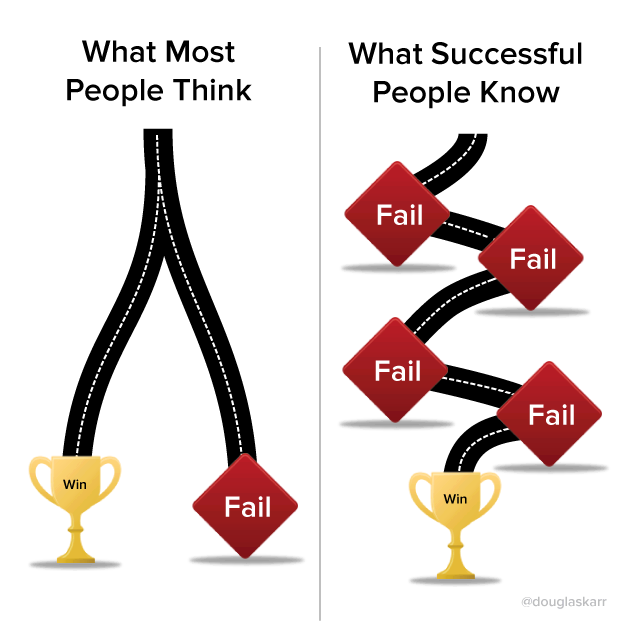
70% Of innovations fail. True. but Why? Hasn't anybody asked themselves, Why?

Though true that it is a statistic, by far and very far it is NOT a probabilistic number. In my 15 years of processes and innovation culture experience, my conclusion is that 70% of innovations fail for one reason: Idiotic and useless search for the absolute perfection.

All of us humans search, quest, perfection. Except maybe mediocres... of course, they do search the perfect justified, rationalized, lazy, no-risk middle... anyway... Point is:


Absolute perfection does not and will never exist. In innovation processes, a bit less.


FEAR of imperfection is and will always be what halts us: "What will the cute, beautiful girl (or guy) will siay if I talk to her(him)?? better say nothing..." we end up choking... It might have just happened that the cute girl (or guy) was waiting for us to come by and say Hi, but out of fear, nothing happened. I already had the NO, What had I to lose? maybe a bit of EGO... and that'd be it.

Same happens with commercial innovation: "What will people say? My audience? my stakeholders and investors??..." Of course it matters!! but a lot less than any inaction.

Every innovation specialist as myself, we say that a high perfection percentage  will be enough. How High is enough? Well, it is relative to a bunch of different factors and metrics of course, starting with the product, service and circumstances themselves. Mediocre? Never!

There are hundreds, thousands of product examples that go out to market and flunk on every year. Many of them are reborn even stronger. Many times in hands of others. I ask then, Why not in our own hands? Why would we voluntarily leave a golden opportunity pass onto someone else to grab the success?
Xerox's Star OS and mouse rekindle in Apple's IBM and Microsoft's hands
Sony's MP3 in Apple's hands
Microsoft's tablet in Apple's hands... Just to mention a few recent cases.

In my 15 years I have launched a bit under 100 products to market. Some quite successful, some not so much and some died trying. It'd be too arrogant of me to pretend saying that all of them were a commercial success. Nobody can say that. What Nobody says is that all of the ones that died trying were key steppingstones to the ones that became successful! Thus were a success of sorts.

In the "glass half empty... in truth it is full of at least air!" If you don't value air, I'd invite you to stop breathing now...

So at the end of the day, ALL were successful one way or another. The ones win low to no sales allowed us to find the ones that were hugely successful, which otherwise we'd never had found. If I listened to all the oppositioners, we would've never had any successful ones. Nice paradox. The skill lies in seeing, in visualizing, invisioning the potential though partial as it may be or through a path not even heard of.  At times it is even matter of letting things decide by themselves, to state it in some raw form. Of course we enter the 'control-freak's or mega-focused nightmare´s realm.'...

Viagra, resounding commercial failure for years. That is of course until a visionary commercializes it with a never before thought-of intent.

Perfect success measure, as most investors or bosses demands is mostly absurd. There is not enough people on the planet to let everybody's american rotten-zillionaire dreams to hand out to everybody. So, Is that enough reason to abandon all of the ideas? I do not think so, because partial, small successes, even the ones considered as failures in truth are stepping stones for some to truly reach rotten-zillionaire status.

Want something with zero risks? Might as well stop breathing because that is the only true no-risk option.

Finally, the reason why eventually, a giant majority of times people abandon, mostly even before they start... "because there is not enough focus, perfection or [whatever]..."

That is a bunch of rationalized mediocrity. Sorry.


viernes, 2 de agosto de 2013

anti-scumbag cautionary tale // historia de precaucion anti-fechorias y malechores

(English version below)

Viernes filosófico:

¿Porque como sociedad humana adulta, por principio, desconfiamos?
¿Porque, por unos cuantos rufianes e historias de terror, el resto somos tratados como rufianes? ¿Por precaución... ?

Resulta que, en uno de los principios de Psicología dice que: "Como somos tratados es mas un reflejo de como es la otra persona que como somos nosotros en realidad"...

Por tanto, entre mas nos traten con "precaución anti-rufián", resulta por dicho principio de psicología que el rufián es el otro, por lo menos mas que uno mismo... Por tanto, ¿que resulta ser de nuestros gobiernos? ¿O de nuestros bancos?
¿O de algunas de nuestras esposas, que en mi caso de repente, me acusa de estar de mal humor, y por si acaso estoy de mal humor ella se enoja y grita antes?

Todo esto resulta ser mas una respuesta de nuestros egos heridos y vengativos que la realidad, y por tanto nos terminamos convirtiendo en rufianes o en miedosos, todo racionalizado para la protección de nuestro mismo ego, Todo en precaución de que el otro vaya a ser "algo", ¿incluso mas que nosotros? ¿Vale la pena?

"El ojo solo ve lo que la mente esta lista a comprender" - Henri Bergson

Bien se dice que "Todo depende del cristal por le que se mira" Siendo el principal e ineludible cristal nuestro propio cerebro, nuestra mente que, durante toda nuestra propia vida se ha ido moldeando con preconcepciones y prejuicios en precaución de cuidar nuestro propio ego... logico, finalmente. Sin ego terminaríamos siendo algo menos que lombrices, o algo así,...

Ahora bien, Que nos sirve todo esto para, mas que la vida diaria, los negocios, o mas específicamente la innovación, por tanto la supervivencia de los negocios?

La preconcepción de la gente es clave: No por que nos haya ido mal o no hayamos tenido los resultados deseados, no significa que vayamos a seguir teniendo los mismos malos resultados en el futuro.
No porque un contador o tres, nos haya tranzado significa que todos los contadores sean tranzas.
No porque te haya ido mal con un gestor o tres, significa que todos son malos.
No porque un ingeniero sea estúpido significa que todos lo seamos, es mas, en este caso, si que te salio la única piedra en el arroz...

Claro que hay gente malhechora, rufiana, mafiosa y peor... Siempre hay que tomar precauciones, pero no al punto de congelarnos o pretender justificar nuestra propia inacción. Esas justificaciones, conclusiones o racionalizaciones son mas para proteger a nuestro ego miedoso de salir a hacer, a probar, a seguir, a aventarse. Necesitamos ser mas inteligentes y sencillos que nosotros mismos...

"la conclusion es solo el lugar en donde nuestra mente nos dice que ya se canso de pensar" - Amy Rees Anderson

Tocar puertas cansa. Cabildear cansa. Esperar resultados, cansa. Probar nuevas formulas de negocio cansa. PERO:


"la clave del éxito esta en 99% perspiración 1% inspiración. Para que la inspiración te encuentre, te tiene que encontrar trabajando" 
- Pablo Picasso


---------------------------------------------------------

Philosophic Friday:

Why, as an adult human society, just out of the blue, we distrust?
Why, because of just a handful of scumbags and horror stories are we, the rest of us treated as scumbags? Just precaution?

Just so happens that one basic Psychology principle states: "As we are treated is more a reflection of how the other person is, than of what we ourselves are in reality"...

Ergo, for more we are treated with "anti-scumbag precaution", just so happens for the principle that the other guy is the scumbag, at least more than oneself...  Why would that state for our governments? And our banks? or even some of our wives that just out of caution, just in case she accuses me of, perhaps, being in a bad mood so she barks at me first?

This is in in truth more a hurt and vengeful ego response than reality itself, therefore we end up becoming scumbags or frightened kittens ourselves, everything rationalized into a protective shield of our own ego, everything "just in case" the other guy might be "something"... even more than ourselves? Is that really worth it?

"The eyes will only see what the mind is ready to comprehend" - Henri Bergson

There is also the proverb: "It all depends of the crystal we see through" being evidently and inescapably our own brains, our own mind the main crystal we see everything through it, that throughout all our lives has been molded into preconceptions, prejudgements and precautions just to protect our own ego... At the end of the day it is only logical. Without ego we'd all be a bit less than slugs, or something...

Now, what does all this mean for, beyond our own daily lives, business or rather, innovation, thus business survival?

People preconceptions is the key: Not because we've been burned in the past means that we'll be burned in the future.
Not because an accountant, or three, scammed us means that every accountant is a scammer.
Not because you had a bad lobbyist means that everyone will be...
Not because you crossed paths with a stupid engineer means that, in fact, you may have found the only bean in the rice pot.

But of course there are scumbags, mobsters, and plenty of illhearted people... So of course we must take precautions everywhere, but not to the point of freezing, not to the point of inaction. This justifications, conclusions or rationalizations are nothing else but our own frightened egos protecting themselves to not try again, to continue trying, to fly again. We need to be smarter and humbler than ourselves...


"A conclusion is the place where you got tired of thinking" - Amy Rees Anderson

To knock on doors is tiresome. To lobby is tiresome. To wait for results is tiresome. To try new business formulas and models is tiresome. BUT:

"The key to success is 99% perspiration, 1% inspiration. For inspiration to find you, it must find you working" - Pablo Picasso


domingo, 28 de julio de 2013

complaints and other annoyances // quejas y otras molestias

(English version below)
En este, 70avo post publicado, y cumpliendo 11,000 lectores, les comparto una mas de mis Reflexiones dominicales:

¿Porque, como humanos, por un lado nos quejamos de que nadie hace nada, y por otro no lo hacemos nosotros mismos?
Aunque es cierto que la innovación no crece en los arboles ni florece en el vacío, según grandes expertos en la historia se han establecido muchas reglas, tal vez demasiadas, por lo tanto, de las cuales yo considero estas 3, los pilares:

"Todo se conecta con todo, solo se requiere tener la habilidad para ver esas conexiones" - Leonardo DaVinci
"Mas importante que la inteligencia, es la imaginación" _ Albert Einstein
"La creatividad es la inteligencia divirtiéndose" - Albert Einstein

Entonces, ¿Porque nos empeñamos en exigirnos cosas de la nada, exprimir nuestros cerebros al máximo de conocimiento y limitando la imaginación y la diversión al mínimo?

"There are only two rules to write:
have something to say, and say it"- Oscar Wilde
Y por otro lado, todo copiamos, no nos aventamos a explorar, todo lo queremos "peladito y a la boca"...

¿Porque, entonces dejamos de estar copiandonos, no nos metemos en donde no nos importa, hacemos lo que tengamos que hacer para mejorar nuestro mundo Y al mismo tiempo hacer algo de dinero?. ¿Es eso tan difícil?? No, no lo creo.

¿Idealista? algo. ¿Realista? Totalmente.
-----------------------------------------------------

In this my 70th published post and 11,000nd readership, I share one more of Sunday's Reflections:

Why, as humans, on the one side we complain nobody does nothing, and on the other we don't do it ourselves?
Though true that innovation does not grow on trees nor it will flourish out of a void, according to the biggest experts in history maybe too many rules have been established, out of which I do consider these the 3 main pillars:


"Everything is connected to everything, we just need the skills to find such connections"- Leonardo DaVinci
"More important than intelligence is imagination" _ Albert Einstein
"Creativity is intelligence having fun" - Albert Einstein

Then, Why do we stubbornly demand things from our on self voids, push our brains to fill it with knowledge and at the same time we limit fun and imagination to the minimum?
And on the other end of things, we copy everything, we don't take risks, to explore, we want everything "peeled, mashed and in the mouth"...

Why don't we stop copying, mind our own, do what we have to to better our world and at the same time, make some money. IS that so hard?? I do not think so.

Idealist? somewhat. Realist? Totally.


martes, 23 de julio de 2013

Justhatzophrenia among other mental aillments // Esquezofrenia entre otras enfermedades mentales

(English version below)

¿Que es la Esquezofrenia?

No, no me equivoque al escribir... Por mucho que nuestros correctores ortográficos se enoje.
Es la forma mas clara y simple de encontrar los miedos. Si llego a preguntar "¿Quien tiene miedo?" en un grupo grande de gente, probablemente se muestren tímidamente una que otra manita, asumiendo que vencen el miedo a levantarla. Y si al mismo grupo pregunto: "¿Quien tiene explicaciones de Porque no hacen las cosas??" TOoodos levantaran las manos. Y si pregunto, "¿Quien tiene explicaciones logicas o ilogicas para no hacer lo que saben que deben hacer?" eh, especulo un 10 o 20% levantaran la mano, pero si la segunda pregunta la hago y luego esta ultima, el porcentaje se duplica. Porque?

Simple. Todo psicólogo y uno que otro conocedor del tema sabemos que existen mecanismos de defensa, mecanismos que para auto-proteger nuestro sobre-sensible ego, nos justificamos a veces de las formas mas ridículas y absurdas que la humanidad pueda conocer.

"¿Porque te da miedo subirte a un avión?" - "¡Yo miedo, Jamas! claro que no me da miedo, ES QUE hay demasiados accidentes, y ES QUE ...."
"¿Porque te da miedo salir de noche, si es la colonia mas segura de la ciudad?" - "¡Yo miedo, Jamas! claro que no me da miedo, ES QUE a la secretaria de mi vecino saliendo de madrugada de su casa le paso un auto, (casualidad, igual al de la esposa del vecino), por encima, y ES QUE...."
"¿Porque te da miedo innovar o cambiar lo que sabes que tienes que cambiar?" - "¡Yo miedo, Jamas! claro que no me da miedo, ES QUE siempre se ha hecho así  y ES QUE innovar es muy caro, y ES QUE no tengo tiempo, y ES QUE..."

pura justificación, usualmente ilógica sigue inmediatamente después de toda frase que comienza ES QUE = por tanto lo diagnostico como enfermedad terminal Esquezofrenia. A menos claro, que esta sea tratada por un experto.

las personals falsas
 tiene una imagen que mantener y no enfrentan nada,
 las personas reales, simplemente no les importa
Como quemar 800 calorias en 30 minutos... no es que, mira asi...
el progreso sin cambio es imposible.
Aquellos que no pueden cambiar de opinion,
no podran cambiar nada de nada


---------------------------------------


What is Justhatzophrenia(tm) ?

Nope, your grammar and spelling corrector is right, I meant to write that way, and here's why:
It is the simplest and clearest way to locate fears. If I ever come into a large gathering and ask "Who is afraid?" maybe a couple of shy hands will maybe raise, that is, if they ever surpass the fear of raising their hand. If, to the same group I ask: "Who has an explanation as to Why you don't do things?" Everyone, without exception will raise their hand. And if I ask, Who has a logical or illogical reason as to Why you don't do what you know you Must do?" 10 maybe 20 percent will raise their hand, but if I ask the second question and then the third, likely the percentage will double. Why?

Simple. every psychologist and maybe a few subject connoisseurs will tell you that we all have self defense mechanisms, all designed to protect our overly sensitive ego, we all justify ourselves sometimes in the most ludicrous and absurd manners humanity can ever learn.

"Why are you afraid of airplanes?" - "Me afraid, Never! It's JUST THAT there are too many accidents, and it's just that..."
"Why are you afraid of going out at night if this is the safest neighborhood in town?" - Me afraid, Never! It's JUST THAT one time my neighbor secretary came out very late and she was run over, (very similar to this guys wife's car), and it's just that..."
"Why are you so afraid of innovating or changing what you know you must change?" Me afraid, Never! It's JUST THAT we've done it the same way for 30 years and it's just that... it is too expensive, and it's just that...I don't have the time, It's just that..."

All lame excuses and mental justifications, usually a very illogical chain of words will follow most times the phrase IT'S JUST THAT is uttered, so it is my diagnostic as a terminal disease, Justhatzophrenia(tm). Unless of course, it is treated by an expert.


lunes, 15 de julio de 2013

Linkedin, So What´ up? // ¿Que se y te trae Linkedin?

(English version below)
En respuesta de un articulo publicado en el foro de Harvard de Linkedin.
Cuando empece a usar Linkedin, era un poquitín tarde. Justo había perdido mi empleo sin un centavo a mi nombre por lo que evidentemente estaba contra el reloj. Empece a contactar tanto reclutador, gente de recursos humanos y cazatalentos que el sistema me permitiese, pues de principio, la mayoría estaban a tercer o quinto grado de distancia. Así que mi estrategia fue aceptar toda y cuanta invitación me llegase y yo enviar toda y cuanta invitación pudiese enviar con el objetivo de, ya sabes, conectar con toda gente que no me era posible conocer en persona de primera mano.
También creo y mas aun creía que el trabajo de la gente de recursos humanos y cazatalentos es justamente ese, conocer y conectar a cuanta gente puedan para así cumplir lo mejor posible con el perfil de sus clientes, y en el peor de los casos, ser referido por algún conocido. Me fue terriblemente frustrante encontrar que en la realidad, estas gentes no hacen ni cerca de bien su trabajo, por lo que si me metí en problemas por las reglas controversiales del mismo Linkedin.
De regreso al punto: Si el sistema de Linkedin me hubiese permitido conectar con toda la gente que yo desease crear una relación, nunca hubiese yo que hacer tanta acrobacia como lo que hice para lograr mi cometido. El principio básico de toda red social virtual es justamente, o de perdida debía de ser conocer gente que no conocemos. si las conozco a todas, pues entonces ¿Para Que me sirve Linkedin??
Cierto, existe mucha gente abusiva en todas las redes sociales, pero eso no debe de intimidar a la gente honesta para quienes las redes sociales han sido maravillosamente diseñadas y con el objetivo claro: Mantener conectada y conocer gente nueva. Las herramientas de ignorar y bloquear fueron expresamente diseñadas contra la gente abusiva, pero siempre que prueben ser abusivas. Y ¿Como vamos a saber que son abusivas si no conectamos?
Twitter igual, tienen tanto miedo a que seas Spammer que ya se en definitiva tienen los algoritmos alrevesados, pero que se yo.
De cualquier manera, En los primeros meses siguientes de que me inscribí, en los foros de empleo apenas un puñado de posteos decían: "tienes 1 conexión al publicador de este empleo". Ahora, la gran mayoría dicen que tengo por lo menos una conexión en segundo grado con el publicador. Y la proporción de invitaciones a entrevistas aumento dramáticamente, aun después de que muchas de las conexiones que tengo nunca las he conocido. La verdad es que hay suficiente gente dispuesta a ayudar pues aceptamos, o por lo menos debemos de aceptar el hecho de que NUNCA SABES A QUIEN VAS A NECESITAR EL DIA DE MAÑANA.  Hay un proverbio que dice: "Toda la gente que conozcas tiene un propósito, ya seq que te agreguen algo a tu vida, o tu les agregues algo a la suya". - Así que mas vale conectar al máximo desde hoy.
Y si, gran parte de los negocios que tengo al día de hoy son derivados de alguna conexión en frío que me llego vía Linkedin y con fuertes posibilidades y esperanzas que deriven en negocios gigantescos muy pronto. Y no, no son con ese primer contacto aunque si, por el me entreviste en TV.
¡¡¡Feliz de conectar y concerlos a todos ustedes!!!

mx.linkedin.com/in/mauriciogeraud


---------------
When I started using Linkedin, it was a bit late. I just lost my job without a penny on me and was obviously against the clock. I started reaching out to as many recruiters, HR and headhunters as the system allowed me to, as I couldn't grasp the ones I wanted to as most were 3rd or 5th degrees away. So my strategy was to accept and send as many invitations as possible to, you know, meet people I couldn't actually meet in person. I do believe that HR & HH peoples' jobs IS to meet people to recruit the best possible and if that connection is not the best, perhaps I do know their best fit for You, you know, quid-pro-quo. I was amazed as to how many did not accept my invitation and actually got into trouble with Linkedin's controversial rules. 
Back to the point. If Linkedin system allowed me to reach out and connect to anyone I wished to create a relationship, I wouldn't have had to make such acrobatics to accomplish so. The principle of a virtual social network basic premise is, or at least it should be, to meet people you don't know... If I do know you, then Why in the world would I need Linkedin for?There is a bunch of abusive people in every social network, true, but that shouldn't deter honest people to do what the tool is designed to do: Meet people. Ignoring and Blocking tools are meant against abusive people, once they've proven they are abusive. How can you tell one is, if you've never been connected?
Twitter just as well, they have their antispammer fear up to Wazoo that I am absolutely certain their algorithms are all upside-down, but what do I know.
Anyway, Over the first few months I logged into the jobs forums, pretty much none had a "you have X connections to the job poster". Now I do have at least one second degree connection to most job postings, and the ratio of answered and invitation to a meeting or interview did increase dramatically, even though most connections that accepted me and I have never met. I realized that there is enough people happy to help YOU as most accept, or at least should accept the fact that YOU NEVER KNOW WHO WILL YOU NEED TOMORROW, There is a proverb that goes: "There is always a reason you'll meet people, either they will add something to your life, or you are going to do so to theirs". So I say, might as well start connecting Today.
And yes, most of business I have today is in direct derivation of a Cold Linkedin Invitation I got out of the blue, and hopefully that will spin into a few multimillionaire deals real soon. And no, it is not with the first connector. Thanks to him, I did get a TV interview though.
So Happy to meet Y'all!

mx.linkedin.com/in/mauriciogeraud


domingo, 14 de julio de 2013

sorprendeme // amaze me

(English version below)

Estamos tan enfocados en ser consistentes que perdemos la habilidad de ser sorprendentes. La sociedad nos ha ensenado que la ruta segura es la que uno debe seguir siempre para triunfar... em, y ¿Que pasa con lo sorprendente? Los que triunfan, ¿ninguno es sorprendente? La verdad es que la capacidad de asombro se nos queda en el fondo del cajón del olvido por el diario, Entonces ¿Que? Entonces ¿somos una sociedad de dronos sin cerebro? ¿O sin cojones?

La verdad es que en la enorme, enorme mayoría de los empleos uno esta tan pendiente de lo urgente sobre lo importante, en no arriesgar nada, ni que se lleven una no solo posible sino muy eficiente herramienta de publicidad de nuestros negocios que terminamos amarrando con cadenitas, en vez de darle un voto de confianza al cliente y que se lleve un lindo y útil recuerdo publicitario: "soy orgulloso cliente del Banco xxx", ademas, asumiendo que funciona correctamente el pobre prisionero del mostrador bancario... como si no pudiesen costear unos cuantos billones de bolígrafos...Y se dicen ser "empresas innovadoras".. disculpas, no se puede ser innovador si temes tanto al riesgo que encadenas los bolígrafos... esto pasa en todos lados, pues mi punto no es el bolígrafo... En realidad el punto es, ¿Porque nos tornamos tan en serio a nosotros mismos cada amenaza cuando en realidad todas son una oportunidad?

Estamos, en términos generales, tan acostumbrados a nuestro status-quo, zona de comfort, que cuando llega un disruptor se alaba como Dios descendido a la tierra, como un Steve Jobs o Bill Gates, Michael Dell... o Michael Jordan...

mmm... ¿porque no puedo recordar ningún mexicano que se alabe igual?? Porque tal vez yo si tengo uno que otro, si es que mi memoria pudiese recordar sus nombres, pero el punto es que en la conciencia colectiva, fuera de uno que otro futbolista, actor o actriz de telenovela... que yo personalmente no tengo idea de quien es nadie... ¿Empresarios?? definitivamente tenemos algunos hipervaliosos, pero por desgracia, o no se conocen, o son de hace 3 generaciones, o los acusamos de actividades "grises"... ¿Porque no podemos reconocer el valor de las personas y sus lideres en sus negocios como son?

Ahora, regresando a la reflexión del titulo, estos personajes que sobresalen, los podemos contar con las manos... Y ¿porque? ¿Que los hace diferentes de todo el resto de la población? ¿Preparación o educación formal? hay muchos de ellos sin estudios... ¿Dinero? hay muchos que empezaron de la nada y con nada... Y muchos de los que empezaron con mucho, ahora la están pasando difícil... ¿Trampas, ilícitos, o actividades grises? Nah, la mayoría lo han hecho bien y con ética suficiente.... La enorme mayoría de las publicaciones y escuelas de negocios nos invitan a copiar o replicar el modelo, pero copiar el modelo no ha servido de nada a nadie pues la formula es temporal y personal, pues cada individuo es exactamente eso, individuo y funciona diferente....

La mayoría entonces van a decir que no hay reglas, pero yo si he encontrado una constante... y de esa búsqueda de esa regla y teoría escribo prácticamente todas las semanas...
"Dejad de preocuparte por lo que teneis por perder
 y enfocate a lo que tienes por ganar"

Sorprendeme, sorprendenos entonces...!

solo una reflexión dominguera...


--------------------------


We are so focused in consistency that we lose our own amazement factor. Society has taught us that the safe route is the one we must follow to succeed... um, What happens with the surprising? Out of those who do triumph, Is no one amazing? truth is, amazement is in the lost-n-nerver-to-be-found drawer after all the day to day activities. So, Then what? Are we a brainless drone society? Or just cowards?

Truth is that in the vast majority of jobs we are focused on the urgent over the important, in minimizing risk that some even chain a not only possible but proven effective marketing tool... lets say banks print billions of pens: "I am a proud banker at xxx" and trusting us to do the right thing with it, not that they can't afford a few trillion pens... instead they chain the poor prisioner on top, assuming that is, it works... that happens everywhere, as my point is way further than the pen... The point is, Why arent we tanking ourselves so seriously threatened when it is really an opportunity?


We are, in general terms, so used to our own status quo, our comfort zone, that when a disruptor comes into scene is worshiped as God on Earth, as a Steve Jobs, Bill Gates, Michael Dell or Michael Jordan...

Why can't I remember any one from any other country?? a few soccer players, movie actors and rock stars, but that is it...

Anyway, back to the point, these characters that transcend, we can count them with a few hands... Why? What makes them diferent than the rest of us? Education? nope, there are plenty with no formal education.... Money? there are plenty that started out of nothing and with nothing, and some that started with plenty now are struggling... Cheating, unlawful or gray activities? Nah, most are ethic enough...

The vast majority of publications and business schools invite us to copy or replicate the model, but to copy the model has never worked to anyone as the formula is time sensitive and tremedously personal, as every individual is exaclty that, individual, and functions differently enough...

Most of you will then tell me that there are no rules, but I have found a cosntant... And that quest to find the rule is why I write pretty much every week...

Amaze me, US then.

 Just a Sunday thought...


jueves, 11 de julio de 2013

skepticism and other disclaimers // escepticismos y otras fes de erratas.

(english version below)

Se dice que el 70% de la innovación falla. Resulta que contrario a la creencia popular, y mas de los escépticos, este dato es en base estadística de resultados, no de probabilidades de éxito. Es decir, el que alguien tome la iniciativa de innovar no significa que solo le atinara a 1 de cada cuatro iniciativas que tome. Las razones de falla son tan infinitas como la cantidad de variables, incluyendo las humanas, naturales y de suerte. PEEERO sabiendo que se esta haciendo, prácticamente todas se pueden sortear.

El escepticismo, contrario a lo que los escépticos suponen y asumen, son escuchados por los soñadores. La gran mayoría de escépticos son, con el tiempo, probados erróneos pues los soñadores somos muy a su pesar pesadilloso, mucho, pero mucho mas tercos y obstinados que los escépticos son arrogantes.

Pongamos un ejemplo: desde la Grecia antigua tenemos la leyenda de Icaro, uno, tal vez el primer registro de un humano volando por su propio ingenio y no por un accidente vertical. Mismo ejemplo pagano fue usado por la iglesia, la mayor y gran escéptica de la humanidad, por los siguientes 2000 años para describir su imposibilidad y "atentado en contra de la voluntad de Dios"...

En esos mismos 2000 años tenemos suficientes soñadores y maravillosos intentos cumplidos como los paragliders chinos y de DaVinci, globos aerostáticos, etc. Aun décadas después de los hermanos Wright todavía habían escépticos que seguían balbuceando y vociferando con absoluta seguridad e ineptitud inapológica, mientras los mismos abordaban tremendas latas absurdas y cruzaban los continentes por los aires. Seguían diciendo que "semejantes maquinas no tenían utilidad practica, mucho menos, comercial"...

Sigamos con la premisa inicial: Suponiendo que hubiésemos tomado como estadística de éxito todos los intentos de aviación antes de 1910, era infinitamente menor al 1%... no el 70%. Hoy es cerca del 99%, gracias a la ciencia. No puedo decir que es del 100% pues todavía vemos uno que otro xxxx en televisión haciendo intentos, pero en vez de salir en programas de ciencia, aparecen en "los vídeos mas estúpidos del planeta". Gracias por bajar nuestra estadística de éxito muchachos...!

"Todo es imposible, hasta que alguien lo hace" - proverbio

Ejemplos hay miles de millones. Casi podría enunciar una resistencia fútil por cada invento prospero de la humanidad. Aviación es uno de los que mas grande resistencia ha tenido y ahora es imposible pensar un mundo sil ella. Es decir,  Absolutamente todos los inventores, creativos, visionarios y demás hemos encontrado gran resistencia, siempre. Y es por esta misma resistencia la que nos mueve, asi que gracias por existir.

Por alguna extraña razón (no tan extraña, solo no me quiero clavar en la textura) sobre los años 1850 a 1930, la humanidad ha visto la mayor cantidad de inventos producidos per capita. Parece como si la humanidad entera haya entendido de un momento a otro que la innovación era no solo necesaria, sino vital para la supervivencia económica y mental. ¿Que ha pasado desde entonces? 

En mi experiencia personal, he tenido cientos de barreras de una forma u otra... El que nos enfrentemos a barreras no quiere decir que no sintamos frustración de vez en vez... Resulta que, en asociación con un cliente y amigo desarrollamos un invento (mas el que yo, pero el punto es otro) que tiene el potencial de erradicar en muy buena medida la violencia en las calles del país a un costo unitario muy razonable. Yo tengo un otro amigo que le presentó el sistema al comisario de su localidad, quien respondió: "¿Para que?, si tengo policías suficientes..." - em... "vaya, en serio... nuestro país es uno de los peores rankeados de violencia, sr comisionado..." dije, no creo me haya oído dichoso señor... se nota que tampoco ha oído siquiera hablar de Einstein y su ley de la estupidez:  

"Estupidez es cuando se repiten acciones y se esperan resultados diferentes" - A. Einstein

Parte de mi trabajo y talento como estratega es encontrar el camino, sorteando dichas barreras y encontrar el como si.


Timmy, querido,
no hace falta fe de erratas
Por favor, abra puerta del otro lado


----------------------------


It is said that 70% of all innovation attempts fail. It so happens that, contrary to popular belief, and on top of all skeptics, this datum is based on result statistics, not on success probability. That is, anyone that takes any innovation initiative will not mean that he´ll only hit 1 out of each four attempts will succeed. Failure reasons are as infinite as the amount of variables, including human, nature and yes, luck factors. But, and it is a big However, knowing what you are doing, pretty much all can be sorted out.

Skepticism, contrary to what skeptics assume and presume, are listened by dreamers. Most skeptics are, with time, proved wrong as we dreamers are to their nightmarish burden, much much more stubborn than they are arrogant.

Lets play an example: since ancient Greek tales with the legend of Icarus, one if not the first historic record of a human taking flight by our own wit and not by a vertical accident. Same pagan example was used by the church, the standard of the largest group of skeptics in history, for the following 2000 years to describe that impossibility and "attempt against Gods will"...

during those same 2000 or some years we have enough dreamers and wonderful and successful attempts as the legendary Chinese and Davinci´s paragliders, and maybe we can include the hot air balloons. Still decades after the Wright Brothers humanity had enough skeptics who still babbled around with absolute and inept unapologetic certainty, whilst boarding tremendous and absurd tin cans and going cross-continent air trips. They still said for years: "such machines have no practical, much less economical use..." right...

Lets continue on with the starting premise if I may, assuming that we took the success statistic of every aviation attempt up to 1910, we´d end up with a success rate below 1%... not 70%. Today it must be closer to 99%,  all thanks to knowledge and science. I can´t say 100% thanks to those idiots that we can still watch on some TV shows, but instead of seeing them in science shows we see them on "the most idiotic videos on the planet" kind of shows, so thanks for dropping our science statistics down a notch you guys...!

"Everything is impossible right up to the point when someone does it" - proverb

Examples i can cite billions. I could probably cite a ludicrous blockage attempt versus each and every prosperous invention we humans have. Aviation is one of the most resisted one in human history and now it is impossible to think a world without airplanes. That is, absolutely every inventor, creative, visionary and dreamer has encountered great resistance, always. And it is after all this same resistance the one that moves us, so thank you for existing.

For some strange reason (not that strange but I will not get stuck on the texture) around the 1850s through the 1930s, humanity saw the largest amount of inventions come into fruition percapita in human history. It seems for a moment that most humans saw not only the need, but the vitality for economical and mental survival. What has happened to us since?

In my personal experience I've had hundreds of barriers in some way or another... The fact that we become used to, and strive against the wall out of will does not mean we do not feel frustration from time to time... This time, it just so happens that together with a friend and client we developed an invention (more him than me but beyond the point) that could potentially eradicate crime on our cities streets within a reasonable unit price. I do have another friend who in turn presented our new system to the county's sheriff who answered: "For what? I do have enough policemen..." - em - "really... our country is one of the worst ranked in world's violence, dear mister sheriff..."  I said... don't think the dear sir heard me... neither has he aparently heard about Einstein's definition of the idiot:

"Idiot is that who repeats actions and still expects different results" - A. Einstein


Part of my job and talent as a strategist is to find the way, find the Where's the yes, everywhere.


martes, 2 de julio de 2013

Who is blinder? // Quien resulta mas ciego?

Tengo un invento en la cabeza desde hace unos 20 años.

Conoci a un inventor, ahora buen amigo, y justo una pieza faltante en el rompecabezas, de la materia necesaria para construirlo y con no menos de 40 años de experiencia.

Le platique y me dijo: "maravillosa idea, y sé bien que no existe pues hay limitantes tecnicas que hay que solventar, pero mas que nada, muy noble querer hacer algo por y para nuestros ciegos, pero... crear cualquier cosa para los discapacitados necesita ser donada porque nadie esta dispuesto a pagar un dolar, todas las instituciones a cargo lo quieren regalado. No es negocio para nadie. Me consta, asi tengo decenas de inventos en mi cajón...resolviendo esto, claro que te ayudo!"

Exactamente, no es negocio para nadie, y menos para los discapacitados...

Me pregunto entonces, cientos de millones de ciegos en el mundo -por hablar de una discapacidad puntual- No son negocio?
Yo no tengo la plata para crearlo y a ver que pasa despues. Es mucha plata para hacerlo a traves de un esquema nuevo de crowdfunding, los esquemas tradicionales, uta, menos...

Me pregunto entonces cuantas del 70% de las iniciativas fallidas de innovacion son por simples fallas del sistema, preconcepciones idiotas que "los productos para discapacitados deben ser donados" o "no puede ser negocio" lo que sea...

Supongo termina siendo como los espacios de estacionamiento para discapacitados, que a nadie le importa usarlos hasta el dia que nosotros mismos los necesitamos libres...

Todos estamos tan encerrados en nuestro pequeño mundito que nunca nos paramos a pensar, "Y si yo lo termino necesitando algún dia?" Y con esto me refiero a todo. A la gente, a los aparatos, a la ayuda, a la tecnología.... "nunca me va a pasar a mi", hasta que nos pasa...

Quien resulta mas ciego? El ciego o quien por voluntad propia No quiere ver?

Igual y se queda en mi cerebro otros 10 años... o 100... Lastima.

Nah, seguro sale, la pregunta es cuando y como...

-----------------------------------------

I've had an invention in my head for the past 20 years.

Just met an inventor, who turned to be a good friend now, and I'm sure he's one of the key missing pieces in the jigsaw puzzle, on spot expertise and 40 years experience.

Shared my invention and replied: "Awesome idea, I know for a fact that doesn't exist because we still face a few technical issues we must address, but mostly, very noble of you to have thought and yearned action to help our blind, however... To create anything for the disabled you must donate it because nobody is willing to pay a single dollar. Every institution in charge wants everything for free. Not worth the effort for no one. Believe me, I have dozens of inventions of the sort in my drawer...Solving this issue, I'll be more than happy to help you!"

Exactly then, that is not a business for anyone. Much less the disabled...
 I wonder then, a couple of hundred million blind people in the world - to call out a single disability - Is not a business worth bunch?

Me personally, don't have the resources to create it and see what happens later. It is way too much money to launch it through crowdfunding, and traditional methods much less...

I wonder then, How many of the 70% of failed innovation initiatives are dead just because simple system faults, idiotic preconceptions like "disabled inventions must be donated" or "that can't be a business" or whatever...

I guess it is like disabled parking, nobody cares to park there unless someday you'll be the one needing the free space for yourself...

All of us are so inside our own little world that we never stop and think, "What if, I end up needing that someday?" And with this I mean everything: People, help, gadgets, technology... "that will never happen to me" we say, until it does...

Who is blinder? The blind or the one who willingly won't see?

I guess I'll keep that invention in my head for 10 more years... or 100... pity.

Nah, for sure I'll do it, question is when and how...